If you’re starting your investing journey, you’ve likely come across the term ETF. But what is an ETF, and why do so many investors—both beginners and professionals—favor them?
In this guide, we’ll break down what an ETF is, how ETFs work, the different types of ETFs, and the pros and cons of investing in them. By the end, you’ll have a clear understanding of how to use ETFs to build a diversified portfolio.
What is an ETF?
ETF stands for Exchange-Traded Fund. It’s a type of investment fund that is traded on stock exchanges—just like individual stocks. Each ETF holds a collection of assets, such as stocks, bonds, commodities, or a mix of asset classes.
The primary goal of most ETFs is to track the performance of a specific index, such as the S&P 500, Nasdaq-100, or Russell 2000. When you invest in an ETF, you are buying a small piece of every asset the ETF holds, making it a powerful tool for diversification.
How Do ETFs Work?
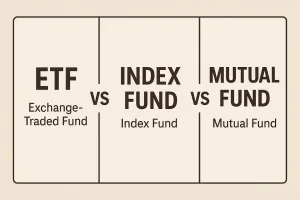
An ETF operates similarly to a mutual fund in terms of pooled investments, but it differs in one key way: ETFs are traded on an exchange throughout the day, just like individual stocks.
Here’s how an ETF works in practice:
- The ETF provider creates a fund that tracks a specific index or sector.
- The provider buys the underlying assets—like Apple, Microsoft, and Amazon for an S&P 500 ETF.
- Investors can buy and sell shares of the ETF on the stock exchange through their brokerage account.
- The price of an ETF fluctuates during market hours, based on supply and demand.
Because ETFs are passively managed (in most cases), they often come with lower fees than actively managed mutual funds.
Common Types of ETFs
There are many types of ETFs, each tailored to different investment goals:
1. Stock ETFs
These track a specific index or sector, such as the S&P 500 ETF (like SPY) or technology ETFs (like QQQ).
2. Bond ETFs
Bond ETFs invest in government or corporate bonds. They’re useful for income generation and diversification.
3. Commodity ETFs
These track the price of commodities like gold (e.g., GLD), oil, or agricultural products.
4. International ETFs
Give exposure to foreign markets, such as emerging market ETFs (e.g., EEM) or developed markets (e.g., EFA).
5. Thematic or Sector ETFs
These focus on specific industries or trends—such as clean energy ETFs, AI ETFs, or real estate ETFs.
6. Inverse and Leveraged ETFs
These are advanced ETFs designed for short-term strategies and speculative trading. They amplify returns or bet against the market and are not recommended for beginners.
Benefits of Investing in ETFs
- Diversification: One ETF can give you exposure to hundreds of companies or bonds.
- Liquidity: ETFs can be bought and sold throughout the trading day.
- Low Fees: Most ETFs have low expense ratios, especially index ETFs.
- Transparency: You can see exactly what’s in the ETF.
- Tax Efficiency: ETFs are more tax-efficient than mutual funds due to their structure.
Risks of ETFs
While ETFs are generally considered safe and efficient, they’re not risk-free:
- Market Risk: If the market or index drops, so will your ETF.
- Liquidity Risk: Some niche or thinly traded ETFs may have wider bid-ask spreads.
- Tracking Error: Some ETFs may not perfectly mirror the performance of their benchmark index.
How to Start Investing in ETFs
Investing in ETFs is easy:
- Open a brokerage account (e.g., Fidelity, Charles Schwab, Vanguard, Robinhood).
- Fund your account with cash.
- Research ETFs that match your goals and risk tolerance.
- Buy shares of the ETF directly on the exchange.
- Monitor your investment periodically and rebalance when needed.
Final Thoughts: Are ETFs Right for You?
ETFs are one of the best tools available for building a diversified, low-cost, and accessible portfolio. Whether you’re saving for retirement, a house, or long-term wealth, ETFs offer a simple way to participate in the market with less complexity and fewer fees.
Still have questions? Drop them in the comments or check out our ETF comparison guides to find the best fit for your investment strategy.
Want to learn more about making a good choice on investing strategies? Check out our Active vs Passive investing blog.