What’s Happening on August 1st?
On August 1st, new U.S. tariffs are expected to go into effect, potentially targeting goods from countries like China, Mexico, or the EU. Whether you’re hearing about this from financial news, your broker, or social media, it’s natural to feel uneasy as a new investor.
So what should you do now?
This guide breaks it all down in simple terms and gives you actionable steps to protect—and even position—your investments for opportunity.
What Are Tariffs and Why Do They Matter to Investors?
Tariffs are taxes placed on imported goods. While they’re meant to protect domestic industries, they often trigger retaliation, supply chain disruptions, and higher prices—all of which ripple through the stock market.
For investors, tariffs can:
- Hurt profits for companies that import goods or materials
- Cause price hikes for consumer goods
- Lead to stock market volatility and uncertainty
- Impact trade-dependent industries like tech, auto, and retail
How Will the August 1st Tariff Deadline Impact the Market?
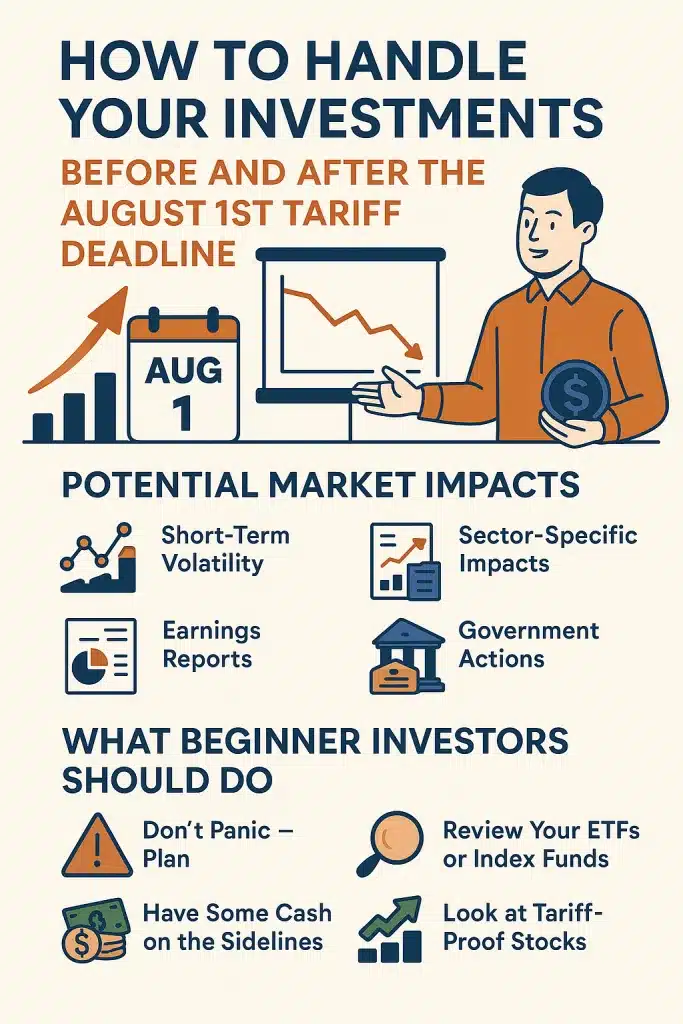
Short-Term Volatility:
Leading up to the deadline, expect increased market swings. Traders and institutions often adjust portfolios ahead of major political or economic events, causing sharp movements.
Sector-Specific Impacts:
- Tech & Electronics: Heavily reliant on overseas parts—tariffs can hit profit margins.
- Retail: May pass price increases to consumers, which can reduce demand.
- Agriculture: Could face retaliatory tariffs from other countries.
- Defense & Utilities: Often more insulated and seen as safe havens.
What Beginner Investors Should Do Before August 1st
- Don’t Panic—Plan.
Emotions are the enemy of smart investing. Reacting emotionally could cause you to sell low or buy high. - Diversify Your Portfolio.
If you’re all-in on tech or retail, consider balancing with safer sectors like healthcare, utilities, or consumer staples. - Review Your ETFs or Index Funds.
Many passive funds have exposure to international companies. Check for those with lower exposure to trade-sensitive sectors. - Have Some Cash on the Sidelines.
Market dips can offer buying opportunities. Keeping 5–10% in cash or cash equivalents (like money market funds) gives you flexibility. - Look at Tariff-Proof Stocks.
Domestic companies or those with strong pricing power (think: food, beverage, energy utilities) may perform better.
What to Watch After August 1st
- Market Reaction (1–5 Days After):
Expect a strong reaction—positive or negative—depending on how severe the tariffs are and whether a resolution seems likely. - Earnings Reports:
Over the next few weeks, see how companies report on the tariffs’ impact. Adjust your holdings based on fundamentals, not fear. - Government & Federal Reserve Actions:
If tariffs disrupt the economy, the Fed may adjust interest rates, which also impacts stocks and bonds.
Long-Term Outlook: Is This a Buying Opportunity?
Yes—if you’re prepared. History shows that geopolitical events often create short-term panic, followed by recovery and growth.
📈 Example:
The U.S.-China trade war of 2018–2019 caused market dips, but the S&P 500 rebounded and grew significantly afterward.
If you’re a long-term investor (5–10+ years), this could be the ideal time to buy quality stocks or index funds at a discount. Just make sure that you have your safety-net in place of 3-12 months worth of savings. This is due to that in the situation the economy is in, unemployment could rise. Ensuring that safety-net will allow you to not have to take money out of the market and secure your long-term wealth.
Final Thoughts: Your 5-Step Checklist
✅ Stay calm and avoid emotional decisions
✅ Review your sector exposure
✅ Rebalance for diversification
✅ Keep some cash ready
✅ Monitor news—but avoid overreacting