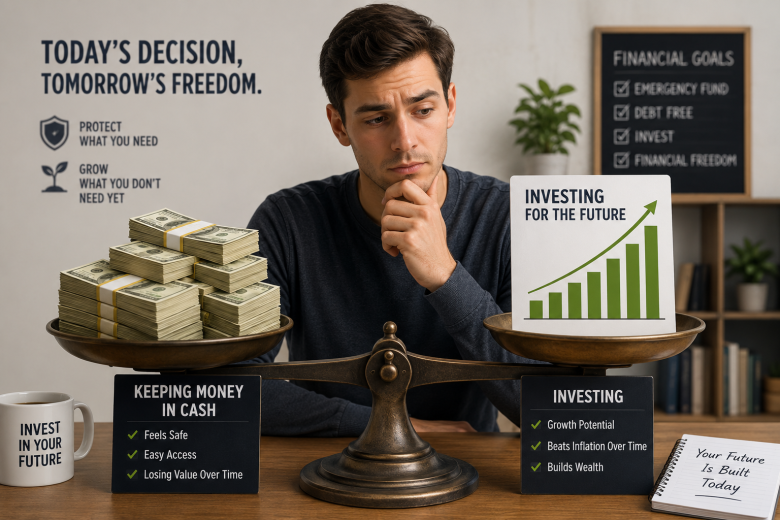
If you’re new to investing, keeping your money in a savings account can feel like the safest thing you can do.
After all, your balance isn’t bouncing around with the stock market. You don’t have to worry about watching your account drop 10%, 20%, or even 30% during a market downturn. You can open your banking app, see your money sitting there, and know exactly how much you have.
What’s not to like?
The problem is that keeping money in cash has a cost, too.
That cost isn’t always obvious. You don’t see your savings account balance going down every month. Instead, inflation can gradually reduce what that money can actually buy, while the money you could have invested isn’t getting the opportunity to grow through compounding.
That doesn’t mean you should invest your emergency fund or every dollar you have.
Cash absolutely has an important role in your financial life.
But if you’re keeping most or all of your long-term savings in cash simply because investing feels intimidating, it may be worth understanding what that decision could cost you over time.
Cash Feels Safe and That’s the Problem
One of the biggest hurdles for beginner investors isn’t necessarily finding an investment.
It’s getting comfortable with the idea that doing nothing with your money is also a financial decision.
Imagine you have $25,000 sitting in a savings account.
You don’t lose a penny of that $25,000 simply because the stock market falls.
That feels reassuring.
But suppose inflation averages 2% per year over a long period. Your account might still show $25,000 years later, but that $25,000 won’t buy as much as it does today.
This is one of the most important concepts for new investors to understand:
Your money can retain its dollar value while losing purchasing power.
The Federal Reserve’s longer-run inflation target is 2%, meaning some level of inflation is considered a normal part of the economy.
Inflation doesn’t necessarily make your bank balance smaller.
It can make the things you’re buying more expensive.
How Inflation Can Eat Away at Cash
Let’s use a simplified example.
Imagine you have $50,000 in cash and inflation averages 3% per year.
After 10 years, you’d still see approximately $50,000 in your account if you earned no interest.
But that $50,000 would have the purchasing power of only about $37,200 in today’s dollars.
That’s more than $12,000 of purchasing power lost.
And you didn’t spend a dime.
That’s what makes inflation so easy to overlook.
There isn’t a transaction on your bank statement saying:
Inflation took $1,000.
Instead, you gradually notice that groceries cost more, housing costs more, insurance costs more, and the same amount of money doesn’t stretch as far.
But What About a Savings Account?
This is where things get a little more complicated.
You might reasonably say:
“My savings account pays interest, so doesn’t that protect me from inflation?”
Sometimes it can help significantly.
A high-yield savings account can provide a much better return than a traditional checking account or low-interest savings account.
But the important number isn’t simply the interest rate you’re earning.
You need to compare your after-tax return with inflation.
For example, if your savings account earns 3% but inflation is 3%, you’re roughly keeping pace before considering taxes.
If your account earns 1% while inflation is 3%, your purchasing power is declining.
And even when savings rates are attractive, there’s another question to ask:
Is cash the best place for money I won’t need for many years?
That’s where investing comes into the conversation.
Cash vs. Investing: What’s the Difference?
Cash and investments serve different purposes.
Cash is designed primarily for stability and accessibility.
Investments are designed to provide an opportunity for long-term growth, but they come with risk.
The SEC describes asset allocation as dividing investments among assets such as stocks, bonds, and cash, with the appropriate mix depending on factors including your time horizon and risk tolerance.
Think of it this way:
| Money | Potential Purpose |
|---|---|
| Checking account | Everyday expenses |
| Emergency savings | Unexpected expenses |
| Short-term savings | Upcoming purchases or expenses |
| Bonds | Potential income and diversification |
| Stock investments | Long-term growth |
| Broad-market ETFs | Diversified long-term investing |
The mistake isn’t having cash.
The mistake can be treating every dollar as if it has the same job.
You Probably Shouldn’t Invest Your Emergency Fund
This is an important distinction.
If you have $15,000 set aside because it’s your emergency fund, putting that entire amount into the stock market probably doesn’t make sense simply because stocks have historically offered greater long-term growth potential.
What happens if your car breaks down during a market downturn?
Or you suddenly lose your job?
You may need that money immediately.
The stock market doesn’t care whether you’re having an emergency.
Your investments could be down precisely when you need to sell them.
That’s why cash can be extremely valuable.
The goal isn’t:
“Get all your money out of the bank.”
The goal is:
“Give your money a job.”
Keep enough readily accessible cash for emergencies and near-term needs. Then consider whether money intended for longer-term goals should be working differently.
The Cost of Waiting Can Be Bigger Than You Think
Here’s where investing becomes especially interesting.
Suppose two people each have $20,000.
Person A keeps the entire amount in cash for 20 years.
Person B invests the $20,000 and earns an average annual return of 7%.
At 7%, the investment would grow to approximately $77,400 after 20 years, assuming the returns compounded annually and no additional contributions.
That’s not a guarantee of what an investment will earn. Markets don’t produce a steady 7% every year.
Some years could be strongly positive.
Other years could be negative.
But the example illustrates the potential power of compound growth.
The difference isn’t necessarily that Person B is smarter.
It’s that Person B gave the money an opportunity to compound.
And the longer the time horizon, the more powerful compounding can become.
Why Starting Early Matters
Time is one of the biggest advantages a beginner investor has.
Consider someone who invests $200 per month starting at age 25 versus someone who waits until age 40.
The person who starts at 25 has an enormous head start—not necessarily because they’re investing huge amounts of money, but because their money has more time to potentially compound.
That’s one reason investing isn’t simply about how much money you have today.
It’s about what you do with that money over the next 10, 20, or 30 years.
If you’re interested in how small amounts can grow over time, check out our guide on [How Much Money Do You Really Need to Start Investing?]. The answer may be less than you think.
You Don’t Have to Pick Individual Stocks
One reason people keep all their money in cash is because they assume investing means picking individual stocks.
It doesn’t.
You don’t have to become the next Warren Buffett.
You don’t have to spend every night studying company earnings.
And you don’t have to guess which stock will be the next big winner.
One approach beginners often explore is investing in broad-market index funds or ETFs.
Instead of buying shares of one company, a broad-market fund can give you exposure to many companies at once.
That diversification can reduce the risk associated with depending on the performance of a single company.
If you’re new to ETFs, our Beginner’s Guide to ETFs is a good place to start.
And if you’re interested in a simple portfolio approach, check out The Simple 3-Fund Portfolio Strategy Explained.
What If the Market Crashes Right After You Invest?
This is probably the biggest fear for someone who has been keeping money in cash.
You finally decide to invest.
Then the market drops 20%.
You immediately think:
“I knew I should have kept it in the bank.”
It’s a completely understandable reaction.
But investing for the long term means accepting that market declines are part of the process.
The solution isn’t necessarily trying to predict when the next crash will happen.
In fact, trying to figure out the perfect time to invest can leave you sitting in cash indefinitely.
Instead, many investors use strategies such as dollar-cost averaging, where they invest consistently over time rather than trying to predict the perfect entry point.
We’ve covered this concept in Always Be Buying: Why Dollar-Cost Averaging Beats Market Timing.
The objective isn’t to eliminate risk.
It’s to build a strategy you can actually stick with.
What About Bonds?
Investing doesn’t have to mean putting everything into stocks.
Bonds can also play an important role in a diversified portfolio.
Generally speaking, bonds can provide different characteristics than stocks, which is one reason they’re often included as part of a diversified asset allocation.
The right mix of stocks, bonds, and cash depends on your goals, time horizon, and tolerance for risk.
That’s another reason beginners shouldn’t think about investing as an all-or-nothing decision.
You don’t have to choose between:
100% cash
or
100% stocks
There are many options in between.
So How Much Money Should You Keep in Cash?
There’s no universal number that works for everyone.
Your appropriate cash reserve depends on your income, expenses, job stability, upcoming financial obligations, and other circumstances.
A reasonable way to think about it is to divide your money into buckets based on when you’ll need it.
Short term
Money you’ll need soon generally belongs somewhere stable and accessible.
Examples include:
- Rent or mortgage payments
- Upcoming bills
- An emergency fund
- Money for a near-term purchase
Medium term
Money you may need in several years requires more thought.
Your investment choices may need to balance growth potential with the possibility that you’ll need the money before a long-term investment horizon.
Long term
Money you don’t expect to need for many years may have a greater opportunity to benefit from long-term investing.
This could include money for retirement or other long-term financial goals.
The key is understanding the difference between saving money and building wealth.
Saving protects money you may need.
Investing gives money an opportunity to grow.
You may need both.
The Real Cost of Keeping Money in Cash
Keeping money in cash doesn’t come with a flashing warning sign.
There’s no notification telling you that your purchasing power is declining.
There’s no statement showing the investment gains you didn’t receive.
That’s what makes the cost so easy to ignore.
If you keep $50,000 in cash for 20 years, you’re not necessarily making a “bad” financial decision.
You may have very good reasons for doing so.
But if that money was intended for a long-term goal, you should at least understand the opportunity you’re giving up by not investing it.
The question isn’t simply:
“Could I lose money if I invest?”
You absolutely could.
The better question is:
“What could I lose by never investing?”
You Don’t Have to Invest Everything Tomorrow
If you’ve been keeping all your money in cash, don’t read this article and feel like you need to immediately move your entire savings account into the stock market.
That’s not the point.
Start by learning.
Understand inflation.
Learn how stocks and bonds work.
Learn what ETFs are.
Understand diversification.
Figure out what money you actually need for emergencies and short-term goals.
Then learn how investing could fit into your longer-term financial plan.
That’s exactly why we created The Investing Blog: to make investing less intimidating for everyday people. You don’t need to know everything before you start learning.
And you don’t need thousands of dollars to begin.
You just need to take the next step.
Final Thoughts: Cash Has a Job—So Should Your Investments
Keeping money in cash isn’t inherently bad.
In fact, having accessible cash is an important part of a healthy financial plan.
The problem comes when all of your money stays in cash simply because investing feels too risky or complicated.
Inflation can reduce purchasing power.
Long periods of cash savings can mean missing out on potential compound growth.
And money that won’t be needed for years may have a different job than money sitting in your emergency fund.
For beginner investors, the goal isn’t to eliminate cash.
It’s to understand why you’re holding it.
Keep the money you need accessible.
Then consider whether your long-term money should have the opportunity to work harder.
If you’re ready to keep learning, explore more beginner-friendly guides here at The Investing Blog. Start small, stay consistent, diversify, and remember: you don’t have to become an expert overnight.
The most important step is simply learning how to make your money work for you.
Important Disclaimer
This article is for educational and informational purposes only and should not be considered personalized financial, investment, tax, or legal advice. Investing involves risk, including the potential loss of principal. Past performance does not guarantee future results. Before making investment decisions, consider your financial goals, time horizon, risk tolerance, and individual circumstances, and consider consulting a qualified financial professional.