Most people who want to start investing don’t lack motivation. They lack a clear starting point. The question “how to invest money” sounds simple enough, but the moment someone opens a brokerage app or searches online, they’re hit with a wall of jargon, conflicting opinions, and products they’ve never heard of. That’s not a personal failure. It’s a genuinely confusing space, and most of the content out there assumes you already know the basics.
This article doesn’t make that assumption. It starts from the beginning and builds from there.
Disclaimer: This article is for educational purposes only and does not constitute personalized financial advice. Every investor’s situation is different. Please consult a qualified financial professional before making investment decisions.
The First Question Isn’t “What to Buy”
When most new investors think about investing, they picture picking stocks or timing the market. But the real first question is much simpler: what are you actually trying to accomplish?
A 28-year-old saving for retirement in 35 years is in a completely different position than a 45-year-old saving for a child’s college tuition in four years. One can afford to ride out a market downturn; the other cannot. That difference, called your time horizon, shapes every decision that follows.
Before choosing a single investment, it helps to define two things: the goal (retirement, a home, financial independence) and the timeline for reaching it. Short-term goals, generally under three years, call for stability over growth. Long-term goals can tolerate more short-term volatility in exchange for higher potential returns over time.
Build the Foundation Before You Invest a Dollar
Here’s something that surprises many beginners: the smartest first move often isn’t investing at all. It’s building an emergency fund.
An emergency fund is three to six months’ worth of living expenses held in a liquid, accessible account, like a high-yield savings account. It exists so that a job loss, car repair, or medical bill doesn’t force you to sell investments at the worst possible moment. Without it, a market dip can become a personal financial crisis.
The logic is simple: investments are meant to stay invested. If the money might be needed within the next year, it shouldn’t be in the market.
Once that safety net is in place, the conversation about how to invest money becomes much more productive.
Understanding Your Relationship With Risk
Risk tolerance is one of those phrases that sounds clinical but actually describes something very human. It’s the question of how you’d genuinely react if your portfolio dropped 20% in a month. Would you stay calm, or would the anxiety become unbearable?
Neither answer is wrong. But being honest about it matters enormously. An investor who panics and sells during a downturn locks in their losses and misses the recovery. A portfolio should be built in a way that makes it possible to hold through turbulence, not just theoretically, but emotionally.
Risk tolerance is shaped by two things: your timeline (longer timelines absorb more volatility) and your personal temperament. A good starting point is to imagine a real scenario, not an abstract one, and ask how you’d respond.
The Main Asset Types, Explained Simply
Once goals, timelines, and risk tolerance are clear, it’s time to understand what’s actually available. The core building blocks of most beginner portfolios are stocks, bonds, and funds.
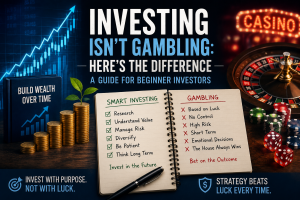
Stocks represent ownership in a company. When the company grows, the value of that ownership tends to rise. Stocks carry more short-term volatility but have historically delivered stronger long-term returns than most other asset types.
Bonds are essentially loans made to a government or corporation. In exchange, the borrower pays interest over a set period. Bonds are generally more stable than stocks but offer lower potential returns. They act as a cushion in a portfolio.
ETFs (Exchange-Traded Funds) and index funds are where most beginners should spend the most time. Instead of picking individual companies, these funds hold a basket of stocks or bonds that track a market index, like the S&P 500. They offer instant diversification, low costs, and no requirement to pick winners. A single index fund can hold hundreds of companies at once.
For most beginners, a low-cost index fund or ETF is the clearest, most practical answer to the question of how to invest money.
Tax-Advantaged Accounts Are a Beginner’s Best Friend
Before putting money into a standard brokerage account, it’s worth understanding the accounts designed to help investors keep more of what they earn.
A 401(k) is an employer-sponsored retirement account. Contributions are made pre-tax, which lowers taxable income today, and the investments grow tax-deferred until withdrawal. Many employers match a portion of contributions, which is effectively free money. Not contributing enough to capture the full match is one of the most common and costly beginner mistakes.
An IRA (Individual Retirement Account) comes in two main forms. A Traditional IRA offers a potential tax deduction now, with taxes paid on withdrawal. A Roth IRA works in reverse: contributions are made with after-tax dollars, but qualified withdrawals in retirement are completely tax-free. For younger investors who expect to be in a higher tax bracket later, the Roth IRA is often especially attractive.
These accounts don’t change what you invest in. They change the tax treatment of those investments, and that difference compounds significantly over decades.
Why Starting Early Matters More Than Starting Big
Compounding is the process by which investment returns generate their own returns over time. It sounds modest, but the math behind it is striking. An investor who starts at 25 and contributes consistently for 10 years, then stops, can end up with more at retirement than someone who starts at 35 and contributes for 30 years, depending on the rate of return.
The variable that matters most isn’t the amount invested. It’s time.
This is why the best answer to “when should I start investing?” is almost always “as soon as the emergency fund is in place and high-interest debt is addressed.” Waiting for the perfect moment or the perfect amount means giving up years of compounding that can never be recovered.
Two Principles That Protect Beginners
Dollar-cost averaging is the practice of investing a fixed amount on a regular schedule, regardless of what the market is doing. When prices are high, that fixed amount buys fewer shares. When prices are low, it buys more. Over time, this smooths out the impact of market volatility and removes the pressure of trying to time the market, something even professional investors consistently fail to do.
Diversification means not putting all of one’s money into a single company, sector, or asset type. A well-diversified portfolio spreads risk so that one bad outcome doesn’t sink the whole ship. Index funds handle most of this automatically, which is another reason they’re a natural starting point.
Mistakes That Set Beginners Back
Trying to pick individual stocks before understanding the basics. Checking the portfolio every day and reacting to short-term swings. Waiting until there’s “enough” money to start. Ignoring fees, which quietly erode returns over years. Letting a strong market make risk feel invisible, or letting a bad month make investing feel hopeless.
These aren’t character flaws. They’re predictable patterns, and knowing about them in advance is most of the protection needed.
The First Steps Are Smaller Than They Seem
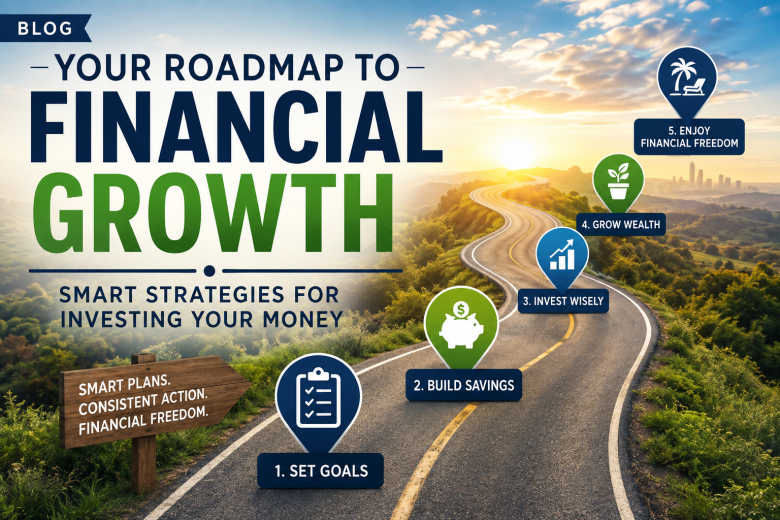
Learning how to invest money is a process, not a single decision. The path forward is clear enough: establish an emergency fund, define a goal and timeline, understand risk tolerance honestly, open a tax-advantaged account if eligible, and start with a low-cost index fund on a regular contribution schedule.
The investors who build real wealth over time aren’t the ones who found a secret strategy. They’re the ones who started, stayed consistent, and let time do most of the work.