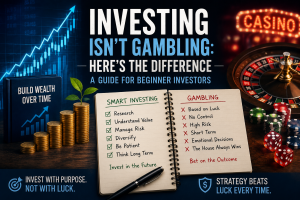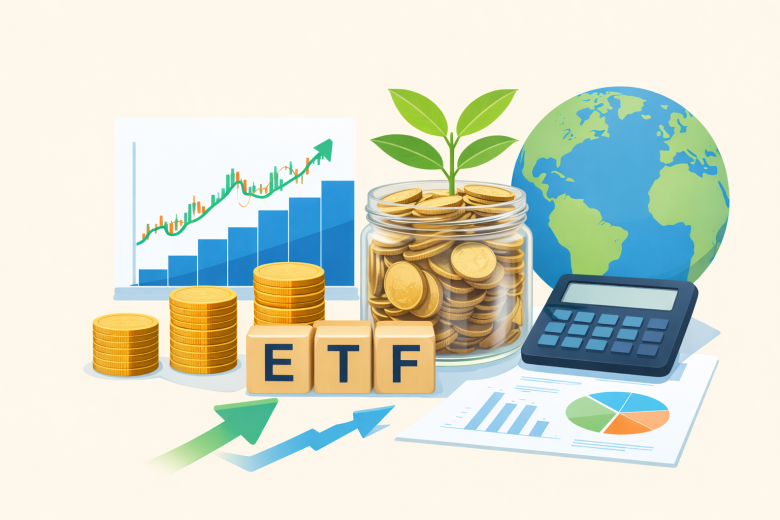
If you’re new to investing and looking for a low-stress way to grow your money in 2026, ETFs (Exchange-Traded Funds) are one of the best places to start.
ETFs let you invest in hundreds or even thousands of companies at once, helping you reduce risk while keeping costs low. In this guide, we’ll break down the best ETFs for beginners in 2026, explain why they’re solid choices, and show you how to build a simple portfolio—even if you’re just getting started.
What Is an ETF? (Quick Beginner Overview)
An ETF is a basket of investments—like stocks or bonds—that trades on the stock market just like a regular stock.
Why beginners love ETFs:
- Instant diversification
- Low expense ratios
- Easy to buy and sell
- Ideal for long-term investing
Instead of picking individual stocks, you can own a slice of the entire market with a single ETF.
How We Chose the Best ETFs for 2026
The ETFs below were selected based on:
- Long-term performance history
- Low fees (expense ratios)
- Broad diversification
- Beginner-friendly simplicity
- Relevance for 2026 and beyond
⚠️ This article is for educational purposes only and not financial advice.
1. Vanguard Total Stock Market ETF (VTI)
Best Overall ETF for Beginners
- Tracks: Entire U.S. stock market
- Expense Ratio: Extremely low
- Risk Level: Moderate
- Ideal For: Long-term growth
VTI gives you exposure to thousands of U.S. companies, from small startups to massive corporations like Apple and Microsoft. If you want a “set it and forget it” ETF, this is one of the best options for 2026.
Why beginners love it:
You don’t need to guess which stocks will win—VTI owns them all.
2. Vanguard S&P 500 ETF (VOO)
Best ETF for U.S. Large-Cap Growth
- Tracks: S&P 500 index
- Expense Ratio: Very low
- Risk Level: Moderate
- Ideal For: Core portfolio holding
VOO focuses on America’s 500 largest companies, which have historically driven most market growth. It’s one of the most popular ETFs in the world—and for good reason.
Beginner tip:
If you only invest in one ETF, many experts would choose VOO.
3. Schwab U.S. Broad Market ETF (SCHB)
Best Low-Cost Alternative ETF
- Tracks: Broad U.S. stock market
- Expense Ratio: Ultra-low
- Risk Level: Moderate
- Ideal For: Cost-conscious investors
SCHB offers similar exposure to VTI but with Schwab’s ecosystem. It’s a great choice if you use a Schwab brokerage account or want maximum diversification at minimal cost.
4. Vanguard Total International Stock ETF (VXUS)
Best ETF for International Diversification
- Tracks: Stocks outside the U.S.
- Expense Ratio: Low
- Risk Level: Moderate
- Ideal For: Global exposure
If all your investments are in U.S. stocks, you’re missing out on the rest of the world. VXUS gives you access to developed and emerging markets, helping reduce country-specific risk.
2026 investing insight:
Global diversification matters more as markets become increasingly connected.
How Much Money Do You Need to Start Investing in ETFs?
Good news: You don’t need a lot.
Many brokerages allow:
- Fractional ETF shares
- $0 trading commissions
- Automatic monthly investing
You can start with as little as $25–$100 and build over time.
ETFs vs. Individual Stocks: Which Is Better for Beginners?
| Feature | ETFs | Individual Stocks |
|---|---|---|
| Risk | Lower | Higher |
| Diversification | Instant | Limited |
| Time Required | Minimal | High |
| Beginner-Friendly | ✅ Yes | ❌ Risky |
For most beginners in 2026, ETFs are the smarter choice.
Final Thoughts: Best ETFs for 2026
If you’re just starting your investing journey, ETFs provide a simple, low-cost, and effective way to grow wealth over time. You don’t need to predict market trends or pick winning stocks—just stay consistent and invest for the long term.
Quick recap of the best ETFs for beginners in 2026:
- VTI – Best overall ETF
- VOO – Best S&P 500 ETF
- SCHB – Best low-cost alternative
- VXUS – Best international ETF
Ready to Start Investing?
Consistency beats perfection. Start small, invest regularly, and let time do the heavy lifting.